| nom | Maret_Napoleon |
|---|
| affichage de la vignette | sideThumb |
|---|
| titre (fr) | Maret à Napoléon |
|---|
| titre (en) | Maret to Napoleon |
|---|
| contenu de la page de présentation en markdown (fr) | # Hugues Bernard Maret, correspondance avec Napoléon
## Fiche signalétique de la collection
| Intitulé | Hugues Bernard Maret, correspondance avec Napoléon |
|----------|-------------------------------------------------|
| Date | 1804-1812 |
| Producteur | Hugues Bernard Maret |
|Importance matérielle| 99 lettres en deux fonds |
| Aperçu du contenu | 99 lettres d’Hugues Bernard Maret avec Napoléon retraçant la carrière de celui qui fut ministre secrétaire d’État puis ministre des Affaires étrangères. |
<br>
[Voir les documents]( https://www.napoleonica.org/fr/collections/Maret_Napoleon/search?page=0&pageSize=20)
<br>
## Description détaillée
### Composition
La collection est divisée en deux fonds correspondant aux fonctions qu’Hugues Bernard Maret (1763-1839) a exercées sous l’Empire.
Hugues Bernard Maret fut de 1804 à 1811 secrétaire d’État [voir le contexte]. Dans cette fonction, lorsque Napoléon était en campagne et avant de le rejoindre, Maret en accompagnement des travaux de la Secrétairerie, informait régulièrement l’Empereur de ce qui se passait à Paris. Durant cette période, il fit parvenir 52 lettres publiées ici. Elles sont fréquemment accompagnées de bulletins annexes sur l’opinion, dans les salons, les finances, les festivités, etc.
En avril 1811, Hugues Bernard Maret a été nommé ministre des Relations extérieures. Au début de la campagne de 1812, comme à son habitude, il suivit Napoléon, mais resta à Vilnius dont il fut nommé gouverneur général. En plus des grandes affaires du son ministère, le duc de Bassano administra la Commission provisoire de gouvernement de Lituanie ainsi que les arrières de la Grande Armée. Il devait centraliser la correspondance militaire avec les corps d’armée qui n’étaient pas directement sous les ordres de l’Empereur (Macdonald, Oudinot, Augereau, Schwarzenberg, Reynier, un temps Victor), mais également gérer l’écoulement du flux logistique dont Vilnius était un point nodal[^1].
Surtout, il servit d’intermédiaire entre Paris et l’Empereur en campagne. Il devait tous les jours correspondre avec l’archichancelier Cambacérès qui gérait les affaires courantes de l’Empire, et Savary, ministre de la Police. Dans l’autre sens, il devait informer Napoléon par toutes les estafettes qui quittait Vilnius vers Moscou. Cette correspondance (47 lettres), croisée avec celle de Napoléon, permet de suivre pas à pas la campagne de 1812.
## Historique de la conservation et description physique
Les deux fonds sont conservés dans les archives de la Secrétairerie d’État impériale aux Archives nationales[^2] dans la sous-série AFIV. Conservés au Louvre sous l’Empire, ces fonds ont été transférés aux Archives nationales en août 1848 où ils sont toujours.[^3]
Les lettres de Maret, ministre, secrétaire d’État, à Napoléon sont conservées aux Archives nationales sous la côte <a href="https://www.siv.archives-nationales.culture.gouv.fr/siv/UD/FRAN_IR_003822/d_7_1" target="_blank">AF IV 1042</a>.
Cette correspondance est composée des expéditions envoyées par le ministre à l’Empereur. Issue de la Secrétairerie d’État, les courriers sont écrits de la main du secrétaire d’État, et les missives sont signées par lui. Les rapports et annexes joints aux courriers sont de la main des secrétaires de l’administration que dirige le duc de Bassano.
Les lettres de Maret, ministre des Relations extérieures, gouverneur général de Vilnius sont conservées aux Archives nationales sous la cote <a href="https://www.siv.archives-nationales.culture.gouv.fr/siv/UD/FRAN_IR_003821/d_1_1634" target="_blank">AFIV 1647-1 et 1647-2</a>.
Les lettres de Vilnius sont des minutes ou des copies préparatoires aux courriers définitifs. Pris sous la dictée du duc de Bassano par ses secrétaires, ces documents font l’objet de reprises et de repentirs fréquents. Les expéditions de ces courriers ont disparu dans le brûlement d’Orcha en novembre 1812. Souvent en réponse des lettres de Napoléon, l’orthographe des noms de lieux a été harmonisée pour correspondre à ces dernières.
## Conditions d'accès et fonds complémentaire
La collection transcrite est entièrement disponible sur ce site. Les originaux sont consultables aux Archives nationales.
<div class="medium-image">
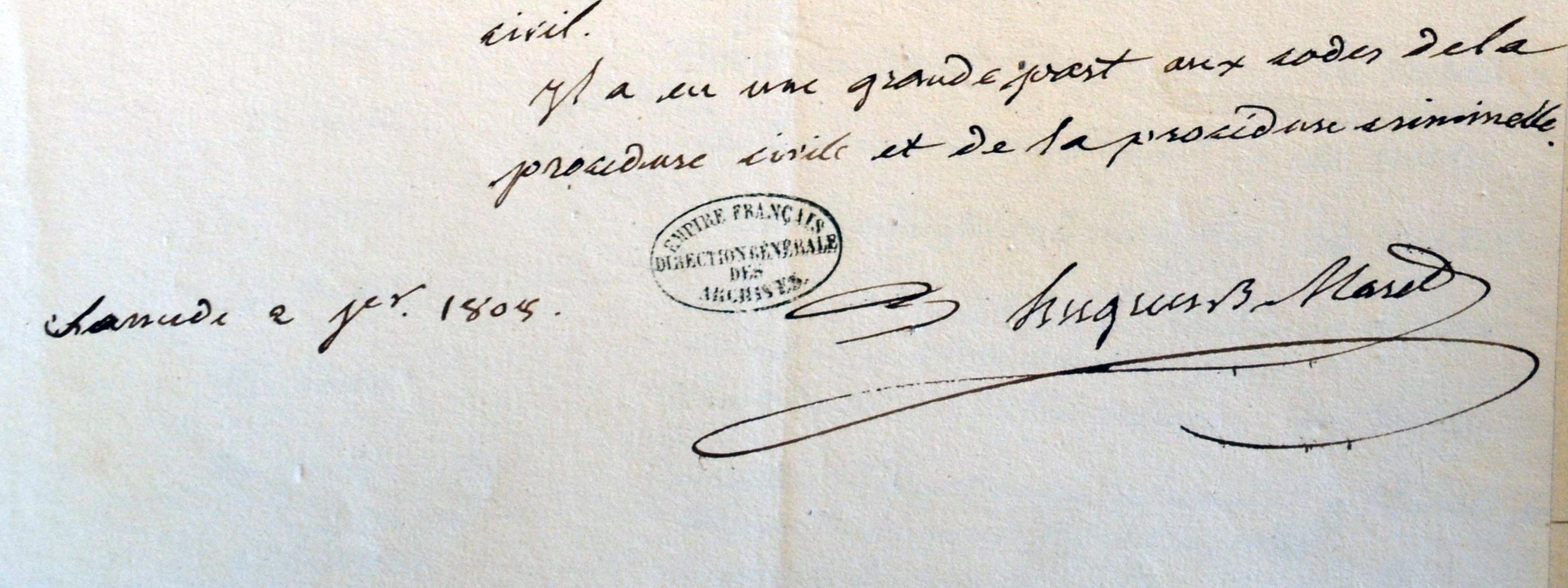
_Maret à Napoléon, 2 janvier 1809 © Fondation Napoléon, Archives nationales, AFIV 1042_
</div>
[^1]: Une partie de la correspondance de Maret sur ces objets est au SHD, C2 121.
[^2]: Les archives nationales conservent en 204 AP un petit fonds Hugues Bernard Maret.
[^3]: Voir l’analyse de <a href="https://shs.cairn.info/revue-napoleonica-la-revue-2022-1-page-40?lang=fr&tab=texte-integral" target="_blank">Jean-Baptiste Auzel</a>, ainsi que celui de <a href="https://shs.cairn.info/revue-napoleonica-la-revue-2020-1-page-6?lang=fr" target="_blank">Cécile Robin</a>
Mise en ligne janvier 2025 |
|---|
| contenu de la page de présentation en markdown (en) | # Hugues Bernard Maret, correspondence with Napoléon
## Introduction to the corpus
| Intitulé | Hugues Bernard Maret, correspondence with Napoleon |
|----------|-------------------------------------------------|
| Date | 1804-1812 |
| Author | Hugues Bernard Maret |
|Volume of material| 99 letters in two collections |
| Content overview| 99 letters by Hugues Bernard Maret to Napoleon tracing his career as Minister of State and then as Minister of Foreign Affairs. |
<br>
[See the documents !]( https://www.napoleonica.org/en/collections/Maret_Napoleon/search?page=0&pageSize=20)
<br>
## Detailed description
### Physical description
The collection is divided into two collections corresponding to the positions held by Hugues Bernard Maret (1763-1839) during the Empire.
Hugues Bernard Maret was Secretary of State from 1804 to 1811 [see Context??]. In this capacity, Maret not only performed the work of the Secretariat but also regularly provided the Emperor on campaign with information on what was happening in the capital. During this period, Maret sent 52 letters, all of which are published here. These are frequently accompanied by bulletins on opinion in the salons, festivities, public finance, etc.
In April 1811, Hugues Bernard Maret was appointed Minister for Foreign Affairs. He accompanied Napoleon on the 1812 campaign but remained in Vilnius, where he was appointed Governor General, thereupon administering the Provisional Commission for the Government of Lithuania and the rear of the Grande Armée, in addition to the major affairs of his ministry. Another of his roles was to centralise military correspondence with corps that were not directly under the Emperor's orders (Macdonald, Oudinot, Augereau, Schwarzenberg, Reynier and, for a time, Victor), and also manage campaign logistics, of which Vilnius was a nodal point.[^1]
Above all, he acted as an intermediary between Paris and the Emperor on campaign, corresponding daily with the archchancellor Cambacérès, who managed the Empire's current affairs, and Savary, the Minister of Police. In the other direction, he saw to the sending of estafettes from Vilnius to Napoleon heading for Moscow. When cross-referenced with Napoleon's letters, this correspondence (47 letters) provides a full, step-by-step view of the 1812 campaign.
## Conservation History
Both collections are held in the archives of the Imperial Secretariat of State at the Archives Nationales in the sub-series AFIV. These collections were kept in the Louvre during the Empire and transferred to the Archives Nationales in August 1848, where they remain to this day.[^2]
The letters from Maret, Minister, Secretary of State, to Napoleon are kept at the Archives Nationales under reference AF IV 1042. https://www.siv.archives-nationales.culture.gouv.fr/siv/UD/FRAN_IR_003822/d_7_1
This correspondence consists of dispatches sent by the minister to the Emperor. The letters, which issued from the Secretariat of State, were written in the handwriting of the Secretary of State and are missives are signed by him. The reports and annexes attached to the letters were written by the secretaries of the administration headed by Maret.
The letters from Maret, Minister for External Relations, Governor General of Vilnius, are kept at the Archives Nationales under the reference <a href="https://www.siv.archives-nationales.culture.gouv.fr/siv/UD/FRAN_IR_003821/d_1_1634" target="_blank">AFIV 1647-1 et 1647-2</a>.
The Vilnius letters are minutes or preparatory copies of the final letters. Taken from Maret’s dictation by his secretaries, these documents were subject to frequent revisions and corrections. The sent version of these letters were lost when Orcha was burned in November 1812. Since Maret’s letters here were often dictated in response to Napoleon's letters, we have harmonized the spelling of the place names in Maret’s letters to match those of the Emperor’s.
## Conditions of access and use
The originals can be consulted at the Archives Nationales.
<div class="medium-image">
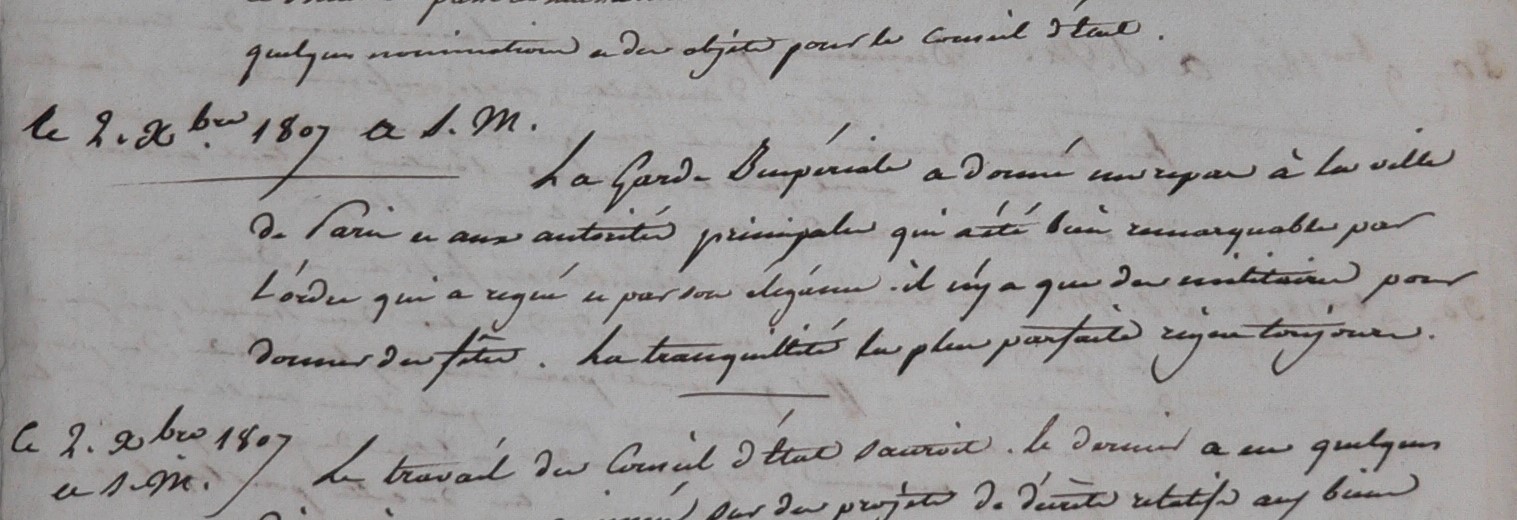
_Lebrun to Napoleon, letter dated 2 December 1807 ©Fondation Napoléon, Archives familiales descendance Lebrun_
</div>
[^1]: Some of Maret's correspondence on these affairs is at the SHD, C2 121.
[^2]: See here the article, in French, by <a href="https://shs.cairn.info/revue-napoleonica-la-revue-2022-1-page-40?lang=fr&tab=texte-integral" target="_blank">Jean-Baptiste Auzel</a>, and <a href="https://shs.cairn.info/revue-napoleonica-la-revue-2020-1-page-6?lang=fr" target="_blank">Cécile Robin</a> . |
|---|
| contexte en markdown (fr) | #La secrétairerie d’État impériale : dans l’ombre de Napoléon
<div class="medium-image">
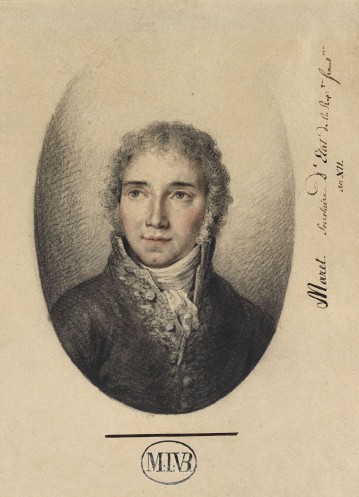
_Hugue-Bernard Maret, duc de Bassano (1763-1839), 1805, Mathieu Ignace van Brée. Photo © RMN-Grand Palais (musée du Louvre) / Adrien Didierjean_
</div>
##Au cœur du pouvoir
S’il est une administration méconnue sous l’Empire, c’est bien celle de la Secrétairerie d’État, pourtant rouage essentiel du pouvoir impérial. Á Sainte-Hélène, Napoléon dira à propos de son chef : « Du ministre secrétaire d’État émanaient tous les actes. C’était le ministre des ministres, donnant vie à toutes les actions intermédiaires ; le grand notaire de l’Empire, signant et légalisant toutes les pièces ». Après chaque conseil de gouvernement, la secrétairerie en rédigeait le compte rendu et consignait les décisions rendues. Tous les jours, le gouvernement y déposait aussi tous les actes signés, de ses réponses officielles aux projets de loi. Un procès-verbal quotidien servait de référence pour embrasser d’un seul coup d’œil toute l’action gouvernementale. Une fois enregistrées par la Secrétairerie, les décisions prises devenaient officielles. Des copies étaient effectuées pour être ensuite archivées selon un classement méticuleux par ministères. D’autres étaient expédiés aux ministères concernés.
Outre son rôle d’enregistrement et de diffusion, la Secrétairerie était aussi la mémoire de l’État. Au lieu d’être conservés par les ministères, tous les actes du gouvernement étaient rassemblés à un seul endroit et à discrétion du souverain. À l’aide d’un index constamment mis à jour, comprenant des entrées chronologiques ou par matières, il était facile de retrouver ce qui avait été acté plusieurs semaines, mois ou années auparavant. Comme pour toutes les autres branches de l’administration, Napoléon avait donc souhaité centraliser ce que l’on pourrait appeler le greffe de l’Empire. Comme le remarqua son secrétaire, le baron Fain, cette organisation facilita grandement son travail : « Il apprécia, écrivit-il, au premier coup d’œil toutes les facilités qu’elle offrait pour rattacher les huit ministères à un centre et leur imposer un formulaire commun, pour simplifier les rapports journaliers avec ses ministres, et même se passer de chacun d’eux quand cela lui plaisait »[^1].
Ainsi Napoléon pouvait-il travailler au secret quand il le désirait, quel que soit le sujet. Afin de nourrir sa réflexion, la Secrétairerie réalisait également un important travail préparatoire, rassemblant tout ce qui concernait le sujet traité. Ainsi les dossiers comme les demandes arrivaient-ils parfaitement complétés sur la table du souverain. Ensuite, Napoléon était à même en seulement quelques heures de trancher un nombre toujours plus important de questions. Cette aide fut précieuse à bien des égards à un homme décidant d’à peu près tout et dans un temps très court et souvent loin de Paris : « Je faisais parvenir mes décisions et mes volontés dans toutes les directions et partout ; si bien qu’avec le Secrétaire d’État et une demi-douzaine de secrétaires, je pouvais gouverner l’Empire du fond de l’Illyrie ou des rives du Niémen avec autant de facilité que dans ma capitale » confia-t-il aussi à Sainte-Hélène.
Sans cette formidable machine administrative, il n’aurait en effet jamais pu gouverner de manière aussi personnelle un Empire de près de quarante millions d’âmes avec autant de rapidité et d’efficacité. Sous la férule de Maret, la Secrétairerie ne fut jamais prise en défaut et devint une administration si parfaite qu’on en oublia même son existence : « Si son action a été́ à peine soupçonnée, c'est que, circonscrite entre l'Empereur et les ministres, il suffisait à l'Empereur qu'elle fût confidentielle, tandis qu'il importait peu à l'amour-propre des ministres qu'elle fût révélée dans toute son étendue. Pour l'œil du vulgaire, le ministère de la secrétairerie d'État, trop voisin du foyer lumineux, se perdait comme certaines planètes dans le disque du soleil » raconta aussi le baron Fain[^2] . Elle fut d’ailleurs à ce point confondue avec Napoléon que la signature de son ministre valait celle du souverain, ce qui évitait à ce dernier de longues et fastidieuses séances de signature. Le rôle de la Secrétairerie fut aussi normatif. En son sein, elle conservait également tous les modèles de décrets, de discours ou de rapports qu’il fallait suivre pour rédiger quelque chose. Ainsi, des préfets aux ministres, personne ne pouvait ignorer les formules, titres ou préséances qu’il convenait de respecter.
##Une administration en croissance
La Secrétairerie était très structurée autour de quatre divisions, de deux bureaux et d’une section d’archives. Les divisions correspondance et procès-verbaux préparaient et enregistraient les actes officiels tandis que la division expédition, la plus importante en nombre avec dix-neuf employés, se chargeait de les diffuser. Composé de dix personnes, le bureau du répertoire tenait à jour l’index général quand celui du départ vérifiait avant envoi les expéditions finales. Un artiste écrivain y exerçait en permanence son art de la calligraphie. Enfin les archives étaient divisées en deux sections (actes et décrets, bibliothèque historique). Si pendant la période consulaire, les effectifs de la Secrétairerie restèrent stables, ils progressent sensiblement en revanche ensuite, passant de trente-cinq personnes dans les années 1800 – 1805 à cinquante-trois personnes en 1814, soit une hausse de près de 50 % en l’espace d’une dizaine d’années[^3] . Cette croissance témoigne à la fois du rôle central comme de plus en plus important voulu par Napoléon de cette administration au sein de l’organisation de l’État. Néanmoins, compte tenu de l’ampleur du travail effectué, les effectifs de la Secrétairerie paraissent bien modestes. On peut donc penser que pour chaque agent, la charge de travail était importante et nécessitait de longues heures de présence dans les bureaux. Pour soulager leur peine, trente-huit gagistes furent sollicités selon les périodes. Au total, cent sept personnes fréquentèrent les bureaux de la Secrétairerie, ce qui reste somme toute modeste.
<table width="580">
<tbody>
<tr>
<td width="353">
<p><strong>Effectifs</strong></p>
</td>
<td width="76">
<p><strong>1800</strong></p>
</td>
<td width="76">
<p><strong>1805</strong></p>
</td>
<td width="76">
<p><strong>1814</strong></p>
</td>
</tr>
<tr>
<td width="353">
<p><strong>Division Expédition</strong></p>
</td>
<td width="76">
<p> </p>
</td>
<td width="76">
<p>13</p>
</td>
<td width="76">
<p>19</p>
</td>
</tr>
<tr>
<td width="353">
<p><strong>Bureau du répertoire</strong></p>
</td>
<td width="76">
<p> </p>
</td>
<td width="76">
<p> </p>
</td>
<td width="76">
<p>10</p>
</td>
</tr>
<tr>
<td width="353">
<p><strong>Bureau du départ</strong></p>
</td>
<td width="76">
<p> </p>
</td>
<td width="76">
<p>2</p>
</td>
<td width="76">
<p>2</p>
</td>
</tr>
<tr>
<td width="353">
<p><strong>Division correspondance</strong></p>
</td>
<td width="76">
<p> </p>
</td>
<td width="76">
<p>4</p>
</td>
<td width="76">
<p>4</p>
</td>
</tr>
<tr>
<td width="353">
<p><strong>Division Procès-verbaux</strong></p>
</td>
<td width="76">
<p> </p>
</td>
<td width="76">
<p>5</p>
</td>
<td width="76">
<p>4</p>
</td>
</tr>
<tr>
<td width="353">
<p><strong>Division fonds et comptabilité</strong></p>
</td>
<td width="76">
<p> </p>
</td>
<td width="76">
<p> </p>
</td>
<td width="76">
<p>1</p>
</td>
</tr>
<tr>
<td width="353">
<p><strong>Sous Total 1800</strong></p>
</td>
<td width="76">
<p>28</p>
</td>
<td width="76">
<p> </p>
</td>
<td width="76">
<p> </p>
</td>
</tr>
<tr>
<td width="353">
<p><strong>Archives</strong></p>
</td>
<td width="76">
<p>7</p>
</td>
<td width="76">
<p>7</p>
</td>
<td width="76">
<p>7</p>
</td>
</tr>
<tr>
<td width="353">
<p><strong>Bibliothèque historique</strong></p>
</td>
<td width="76">
<p> </p>
</td>
<td width="76">
<p>2</p>
</td>
<td width="76">
<p>1</p>
</td>
</tr>
<tr>
<td width="353">
<p><strong>Cabinet particulier</strong></p>
</td>
<td width="76">
<p>2</p>
</td>
<td width="76">
<p>2</p>
</td>
<td width="76">
<p>5</p>
</td>
</tr>
<tr>
<td width="353">
<p><strong>Total</strong></p>
</td>
<td width="76">
<p><strong>35</strong></p>
</td>
<td width="76">
<p><strong>35</strong></p>
</td>
<td width="76">
<p><strong>53</strong></p>
</td>
</tr>
</tbody>
</table>
Le personnel de Maret était plutôt bien rémunéré, de l’ordre de 20 à 30 % que ce qui se pratiquait dans les autres administrations. Un chef de service percevait 10 000 francs à l’année, un sous-chef, 4 000 francs, un commis de bureau, 2 400 francs et un expéditionnaire, entre 1 500 et 1 800 francs. Le ministre recevait quant à lui 80 000 francs, une somme très élevée, mais toutefois inférieure aux 200 000 francs que recevaient les autres ministres. En 1815, le traitement moyen était de 3 207 francs à l’année. La rémunération annuelle moyenne étant d’environ 1 000 francs sous l’Empire, les employés de la Secrétairerie recevaient donc un traitement trois fois supérieur. Cette largesse impériale s’explique sans doute par la qualité comme l’importance du travail fourni. En outre, pour préserver le secret de l’État, il fallait pouvoir compter sur la discrétion absolue de tous ceux qui travaillaient autour du ministre. Pour tenter de prévenir toute corruption, il valait mieux remplir leurs poches plutôt que de les exposer à la tentation. D’autre part, on évitait aussi par cette politique des démissions en nombre. Ainsi motivés, les agents restaient en poste plus longtemps, acquérant au passage toujours plus d’expérience. Sur les 69 employés permanents qui avaient été recrutés au fil des années, 53 étaient toujours en poste en 1814. En près de quinze années, le taux de départ fut donc de moins de 25 %. Du reste, plusieurs commis ou expéditionnaires avaient déjà servi sous la Révolution au sein du secrétariat général du Comité de Salut public. Grâce à cette stabilité, la Secrétairerie d’État resta une administration performante comme très discrète. Au niveau budgétaire, elle connut également une hausse logique de ses moyens puisque l’essentiel de ses dépenses était consacré aux traitements de ses employés. Son budget passa ainsi de 294 000 francs en 1804 à 417 000 francs en 1813. Malgré cette augmentation, le coût de la Secrétairerie était presque anecdotique comparé à celui d’autres ministères, tels que ceux des Finances et du Trésor (22 millions en 1813) ou de la Justice (21 millions en 1813).
Dans les comptes de l’État, le budget de la Secrétairerie n’y figure cependant pas, car il était pris en charge directement par l’empereur sur les fonds de sa Liste civile. Dotée de 25 millions par an, celle-ci permettait au souverain de régler ses dépenses personnelles comme celles de sa cour. En faisant le choix de payer lui-même les frais de la Secrétairerie, Napoléon la contrôlait évidemment d’autant mieux. Aucune publicité n’étant donnée à ses comptes contrairement aux autres administrations, il n’est pas étonnant en outre que son action soit restée longtemps ignorée. D’un naturel méfiant, y compris vis-à-vis de son propre État, l’empereur fit donc de la Secrétairerie une administration entièrement dépendante de sa seule personne. Par ce choix, on mesure à quel point il fit sien le gouvernement de la France en concentrant ainsi tout le processus décisionnaire entre ses mains : « Du moment, disait-il également, que les ministres, chacun dans sa partie, s’attribuent les fonctions de secrétaire d’État, tous les éléments de centralisation, tous les moyens matériels de contrôle disparaissent et rien ne peut aider le chef de l’État à connaître par lui-même l’ensemble de ses affaires. Les fenêtres du cabinet se bouchent et l’observatoire du maître n’est plus qu’une chambre obscure qui a perdu sa vision magique »[^4] . De fait, il priva volontairement ses ministres d’un outil de pouvoir essentiel, faisant d’eux de simples exécutants. Travaillant régulièrement au plus de près l’empereur, de Maret à Daru, le ministre secrétaire d’État prit en revanche une certaine importance, jusqu’à susciter la jalousie de ses collègues.
Texte rédigé par Pierre Branda
Mis en ligne janvier 2025
[^1]: Fain, <i>Mémoires</i>, Paris, Perrin, 2020, p. 237.
[^2]: <i>Ibid</i>.
[^3]: L’étude qui suit a été faite grâce au dépouillement du fonds AF IV 1326 des Archives nationales.
[^4]: <i>Ibid.</i>, p. 240. |
|---|
| contexte en markdown (en) | #The Imperial Secretariat of State: in Napoleon’s shadow
<div class="medium-image">

_Hugue-Bernard Maret, duc de Bassano (1763-1839), 1805, Mathieu Ignace van Brée. Photo © RMN-Grand Palais (musée du Louvre) / Adrien Didierjean_
</div>
##At the heart of power
If there was one little-known administration under the Empire, it was the Secretariat of State, despite the fact that it was an essential cog in the wheel of imperial power. On St Helena, Napoleon said of the head of the Secretariat: “All acts emanated from the Minister Secretary of State. He was the minister of ministers, giving life to all intermediate actions; the great notary of the Empire, signing and legalising all documents.” After each cabinet meeting, the secretariat drew up the minutes and recorded the decisions taken. Every day, the government also filed all its signed documents there, from official replies to bills. A daily record served as a reference for all government action at a glance. Once recorded by the Secretariat, the decisions taken became official. Copies were made and then filed meticulously by department. Others were sent to the ministries concerned. In addition to its role of recording and disseminating information, the Secretariat was also the memory of the State. Instead of being kept by the ministries, all the acts of the government were collected in one place at the sovereign's discretion. With the help of a constantly updated index, including chronological or subject entries, it was easy to find what had been enacted several weeks, months or years earlier. As with all the other branches of the administration, Napoleon had wanted to centralise what could be called the registry of the Empire. As his secretary, Baron Fain, remarked, this organisation greatly facilitated his work: “He appreciated,” he wrote, “at first sight all the facilities it offered for attaching the eight ministries to a centre and imposing a common form on them, for simplifying day-to-day dealings with his ministers, and even doing without each of them when it pleased him”.[^1]
<br>
This meant that Napoleon could work in secret whenever he wished, whatever the subject. In order to provide food for thought, the Secretariat also carried out a great deal of preparatory work, gathering together everything relevant to the subject in question. In this way, files and requests arrived at the Sovereign's desk perfect and complete. Napoleon was then able to decide on an ever-increasing number of questions in just a few hours. This assistance was invaluable in many ways to a man who had to decide on almost everything in a very short space of time, often far from Paris: “I was able to have my decisions and desires sent in all directions and everywhere; so much so that simply with the Secretary of State and half a dozen secretaries, I could govern the Empire from the depths of Illyria or the banks of the Niemen with as much ease as in my capital”, he also confided on St Helena.
<br>
Without this formidable administrative machine, he would never have been able to govern an Empire of almost forty million souls so personally, so quickly and so efficiently. Under Maret's rule, the Secretariat never failed and became such a perfect administration that its existence was even forgotten: ‘Whilst its action waś barely suspected, it was because, limited to the closed circle of the Emperor and his ministers, it was sufficient for the Emperor that it was confidential, and indeed it was brought no advantages to the self-esteem of ministers that this relationship should be revealed in its fullest extent. For the common eye, the ministry of the secretariat of state, too close to the centre of light, was lost like certain planets in the disc of the sun’, (again Baron Fain). In fact, the Secretariat was so confused with Napoleon that the signature of his minister was equivalent to that of the sovereign, which saved the latter long and tedious signing sessions. The role of the Secretariat was also prescriptive. It also kept all the models of decrees, speeches and reports that had to be followed when writing something. From prefects to ministers, no one was unaware of the formulas, titles or precedence that had to be respected.
##A growing administration
The Secretariat was structured around four divisions, two offices and an archive section. The correspondence and minutes divisions prepared and registered official documents, while the dispatch division, the largest in number with nineteen employees, was responsible for distributing them. The ten-strong directory office kept the general index up to date, while the dispatch office checked the final dispatches before they were sent out. An artist/writer was permanently on hand to practise his art of calligraphy. Finally, the archives were divided into two sections (acts and decrees, historical library). While the number of staff in the Secretariat remained stable during the consular period, it increased significantly thereafter, rising from thirty-five in the years 1800 - 1805 to fifty-three in 1814, an increase of almost 50% in the space of ten years.[^2]
This growth reflects both the central and increasingly important role that Napoleon wanted this administration to play in the organisation of the State. Nevertheless, given the scale of the work carried out, the number of staff in the Secretariat seems quite modest. We can therefore assume that each member of staff had a heavy workload, requiring them to spend long hours in the offices. To ease their burden, thirty-eight ‘gagistes’ were called in from time to time. In total, one hundred and seven people worked in the offices of the Secretariat, which is still a modest number.
<table width="580">
<tbody>
<tr>
<td width="353">
<p><strong>Staff numbers</strong></p>
</td>
<td width="76">
<p><strong>1800</strong></p>
</td>
<td width="76">
<p><strong>1805</strong></p>
</td>
<td width="76">
<p><strong>1814</strong></p>
</td>
</tr>
<tr>
<td width="353">
<p><strong>Division Expédition</strong></p>
</td>
<td width="76">
<p> </p>
</td>
<td width="76">
<p>13</p>
</td>
<td width="76">
<p>19</p>
</td>
</tr>
<tr>
<td width="353">
<p><strong>Bureau du répertoire</strong></p>
</td>
<td width="76">
<p> </p>
</td>
<td width="76">
<p> </p>
</td>
<td width="76">
<p>10</p>
</td>
</tr>
<tr>
<td width="353">
<p><strong>Bureau du départ</strong></p>
</td>
<td width="76">
<p> </p>
</td>
<td width="76">
<p>2</p>
</td>
<td width="76">
<p>2</p>
</td>
</tr>
<tr>
<td width="353">
<p><strong>Division correspondance</strong></p>
</td>
<td width="76">
<p> </p>
</td>
<td width="76">
<p>4</p>
</td>
<td width="76">
<p>4</p>
</td>
</tr>
<tr>
<td width="353">
<p><strong>Division Procès-verbaux</strong></p>
</td>
<td width="76">
<p> </p>
</td>
<td width="76">
<p>5</p>
</td>
<td width="76">
<p>4</p>
</td>
</tr>
<tr>
<td width="353">
<p><strong>Division fonds et comptabilité</strong></p>
</td>
<td width="76">
<p> </p>
</td>
<td width="76">
<p> </p>
</td>
<td width="76">
<p>1</p>
</td>
</tr>
<tr>
<td width="353">
<p><strong>Sub-Total 1800</strong></p>
</td>
<td width="76">
<p>28</p>
</td>
<td width="76">
<p> </p>
</td>
<td width="76">
<p> </p>
</td>
</tr>
<tr>
<td width="353">
<p><strong>Archives</strong></p>
</td>
<td width="76">
<p>7</p>
</td>
<td width="76">
<p>7</p>
</td>
<td width="76">
<p>7</p>
</td>
</tr>
<tr>
<td width="353">
<p><strong>Bibliothèque historique</strong></p>
</td>
<td width="76">
<p> </p>
</td>
<td width="76">
<p>2</p>
</td>
<td width="76">
<p>1</p>
</td>
</tr>
<tr>
<td width="353">
<p><strong>Cabinet particulier</strong></p>
</td>
<td width="76">
<p>2</p>
</td>
<td width="76">
<p>2</p>
</td>
<td width="76">
<p>5</p>
</td>
</tr>
<tr>
<td width="353">
<p><strong>Total</strong></p>
</td>
<td width="76">
<p><strong>35</strong></p>
</td>
<td width="76">
<p><strong>35</strong></p>
</td>
<td width="76">
<p><strong>53</strong></p>
</td>
</tr>
</tbody>
</table>
<br>
Maret's staff were fairly well paid, around 20-30% more than other government departments. A head of department received 10,000 francs a year, a deputy head 4,000 francs, an office clerk 2,400 francs and an ‘expéditionnaire’ between 1,500 and 1,800 francs. The minister received 80,000 francs, a very high sum, but less than the 200,000 francs received by other ministers. In 1815, the average annual salary was 3,207 francs. Since during the Empire the average annual salary was around 1,000 francs, the employees of the Secretariat therefore received a salary three times higher. This imperial largesse can no doubt be explained by the quality and importance of the work performed. In addition, to preserve the secrecy of the State, it was necessary to be able to count on the absolute discretion of all those working around the minister. To try and prevent corruption, it was better to line their pockets rather than expose them to temptation. Furthermore, this policy also prevented a large number of resignations. Motivated in this way, staff stayed in post longer, acquiring more and more experience in the process. Of the sixty-nine permanent employees who had been recruited over the years, fifty-three were still in post in 1814. In almost fifteen years, the attrition rate was therefore less than 25%. What's more, several clerks and ‘expéditionnaires’ had already served in the General Secretariat of the Committee of Public Safety during the Revolution. Thanks to this stability, the Secrétairerie d'État remained a highly efficient and discreet administration. In budgetary terms, it also saw a logical increase in its resources, as the bulk of its expenditure was devoted to the salaries of its employees. Its budget rose from 294,000 francs in 1804 to 417,000 francs in 1813. Despite this increase, the cost of the Secretariat was almost a drop in the ocean compared with that of other ministries, such as those of Finance and the Treasury (22 million in 1813) or Justice (21 million in 1813).
<br>
The Secretariat's budget does not appear in the State accounts, however, as it was paid directly by the emperor from the funds of his Civil List. With an annual budget of 25 million, this allowed the sovereign to pay for his personal expenses and those of his court. By choosing to pay the costs of the Secretariat himself, Napoleon obviously had even greater control over it. Since, unlike other government departments, no publicity was given to its accounts, it is not surprising that its activities passed unnoticed for a long time. Naturally distrustful, including of his own state, the emperor therefore made the Secretariat an administration entirely dependent on him alone. This choice shows the extent to which he made the government of France his own by concentrating the entire decision-making process in his hands: “From the moment”, he also said, “that ministers, each in their own department, take on the duties of Secretary of State, all the elements of centralisation, all the material means of control disappear and nothing can help the Head of State to know all his affairs for himself. The windows of the cabinet were blocked and the master's observatory was no more than a camera obscura that had lost its magic view”.[^3] In fact, he deliberately deprived his ministers of an essential tool of power, turning them into mere executors. Working regularly in close proximity to the Emperor, from Maret to Daru, the Minister of State took on significant importance, to the point of arousing the jealousy of his colleagues.
Text by Pierre Branda
January 2025
[^1]: Jean Agathon Fain, <i>Mémoires</i>, Paris, Perrin, 2020, p. 237.
[^2]: The following study was carried out using the AF IV 1326 fonds of the Archives Nationales.
[^3]: <i>Ibid</i>, p. 240. |
|---|
| est validée | oui |
|---|
| affichée en page d'accueil | non |
|---|
| utilise les facettes | text,authors,date,recipients,places |
|---|
| Ordre d'affichage (plus petit nombre en haut) | 3 |
|---|
| |