| nom | architecture |
|---|
| affichage de la vignette | sideThumb |
|---|
| illustration | ./images/DM_238bis.jpg |
|---|
| titre (fr) | Dessins d’architecture Bibl. Thiers |
|---|
| titre (en) | Thiers Library architectural drawings |
|---|
| description (fr) | L’historien Frédéric Masson a réuni une collection de près de 1 000 dessins conservée aujourd’hui à la bibliothèque Thiers. De ce fonds, la Fondation Napoléon et la Bibliothèque Thiers ont réuni un ensemble de 84 dessins d’architectures représentatifs de la production de la Révolution au Second Empire. |
|---|
| description (en) | Historian Frédéric Masson assembled a collection of almost 1,000 drawings, now housed at the Bibliothèque Thiers. From this collection, the Fondation Napoléon and the Bibliothèque Thiers have assembled a set of 84 architectural drawings, representative of the production from the Revolution to the Second Empire. |
|---|
| contenu de la page de présentation en markdown (fr) | # Dessin d’architecture de la collection Fréderic Masson
## Fiche signalétique de la collection
| Intitulé | Dessin d’architecture de la collection Masson |
|----------|-------------------------------------------------|
| Date | 1788 - 1852 |
| Producteur | Auteurs multiples |
|Importance matérielle| 84 dessins ou croquis |
| Aperçu du contenu | L’historien Frédéric Masson a réuni une collection de près de 1 000 dessins conservée aujourd’hui à la bibliothèque Thiers. De ce fonds, la Fondation Napoléon et la Bibliothèque Thiers ont réuni un ensemble de 84 dessins d’architectures représentatifs de la production de la Révolution au Second Empire. |
[Voir les documents](https://www.napoleonica.org/fr/collections/architecture/search?page=0&pageSize=20)
## Description détaillée
L’historien Frédéric Masson a réuni une collection de près de 1 000 dessins conservée aujourd’hui à la bibliothèque Thiers. De ce fonds, la Fondation Napoléon et la Bibliothèque Thiers ont réuni un ensemble de 84 dessins d’architectures représentatifs de la production de la Révolution au Second Empire.
Sous la direction de la Fondation Napoléon, ce projet a été conduit par Adrián Fernández Almoguera, ancien membre de l’École Française de Rome, et chercheur à l'Université Complutense de Madrid et Pierre Coffy, doctorant en Histoire de l’architecture à l’Université Panthéon-Sorbonne et l’Università degli Studi di Milano, « La Statale ». Ils sont tous deux lauréats de la bourse d’étude de la Fondation Napoléon. Ont également collaboré à la description et au commentaires des dessins : Charlotte Duvette, cheffe de projet « Histoire du quartier Richelieu » du département des études et de la recherche (INHA), et également ancienne boursière, ainsi que Guillaume Nicoud, Post-doctorant en Histoire de l’Architecture à l’Archivio del Moderno, Università deal Svizzera Italiana, Lugano.
Cette équipe a réuni une sélection d’œuvres figurées qui se regroupe en plusieurs ensembles :
- 6 projets de monuments en l’honneur de Napoléon : Statue de l’Empereur en législateur du Code Civil par Prud’hon (DM 386), projets de statue équestre (DM 250), ou de monument à Napoléon roi d'Italie (DM 251) etc.
- 14 dessins de monuments ou projets de commémoratifs : dont des projets de colonnes commémoratives départementale pour la ville de Bruxelles (DM 413) ou de Boulogne (DM 258), des projets d’arcs de triomphe (DM 414), ou la Pyramide d’Austerlitz érigée par Marmont au camp de Bruges (DM 155 A), etc.
- 17 dessins ou projets de bâtiments publics ou de leur décoration dont : Théâtre de Strasbourg (DM241 A), Église (DM 239 A-E), frontons du Corps législatif (DM 34-4528) attribué à Chaudet etc.
- 3 projets d’aménagement urbain : notamment un relatif à la série de propositions de réunion du Louvres aux Tuileries (DM 262).
- 7 projets d’aménagements publics : fontaine dite du château d’eau (DM 418 C), fontaine des Innocents (DM 413 D), Tempietto (DM 34-3083), etc.
- 4 dessins d’aménagement intérieur des palais impériaux ou des fêtes impériales, dont un projet pour une salle du trône (Dm 248), ou encore une étude pour le décor de la chapelle éphémère installée dans le Salon Carré du palais du Louvre pour le mariage de Napoléon et de Marie-Louise, le 2 avril 1810 (DM 34-053).
- 3 dessins d’architecture privée, notamment la Villa Bonaparte à Milan (DM 228), ou l'Hôtel de Thélusson (DM 414 B).
- 1 dessin de jeunesse de fortification signé « Buonaparte » (DM 451).
- 27 dessins préparatoires des aménagements pour la cérémonie du Retour des Cendres, le 15 décembre 1840, ou du tombeau de Napoléon inspirés entres autres des propositions de Labrouste et Visconti : catafalque (DM 202) char funèbre (DM 4), poêle (DM 218), carapaçons des chevaux (DM 209) etc.
## Historique de la conservation
<div class="text-small-image">
<div class="side-text">
Le fonds de dessins napoléoniens de la Bibliothèque Thiers provient du legs de Frédéric Masson à l’Institut de France en 1923. Certaines encadrées, d’autres éparpillées à l’origine au milieu des manuscrits de l’historien, ces feuilles ont été ensuite rassemblées, dans les années 1980, en un fonds cohérent, classé de manière thématique.
Dans les années 1970, Hélène Michaud, conservateur de la Bibliothèque Thiers, avait prévu d’exposer par roulement les dessins de la collection. Il semble cependant que ce projet n’ait jamais abouti. Plus récemment, en 1997, David Chanteranne réalisa un nouvel inventaire des dessins, ce qui permit quelques nouvelles attributions.
Il n’est pas toujours aisé de définir la manière dont Frédéric Masson achetait ses dessins : il n’a, en effet, laissé aucunes traces dans ses papiers. Au gré des recherches, on sait néanmoins que certains furent obtenus auprès de grands marchands, comme Elie Fabius, ou lors de ventes importantes, telle la dispersion de la collection du marquis de Chennevières. Beaucoup furent probablement acquis en lots.
Se rapportant tous à l’iconographie napoléonienne, la collection Masson forme un ensemble cohérent. On y retrouve aussi bien une étude préparatoire pour le sacre de Napoléon par Jacques-Louis David, qu’un portrait de Jérôme Napoléon par François Gérard, ou encore un portrait du général Pichegru par Alexandre-Evariste Fragonard, destiné à la gravure. Parmi toutes ces œuvres, un nombre important représente des éléments d’architecture : c’est ce corpus que la Fondation Napoléon et la Bibliothèque Thiers ont souhaité vous présenter ici.
</div>
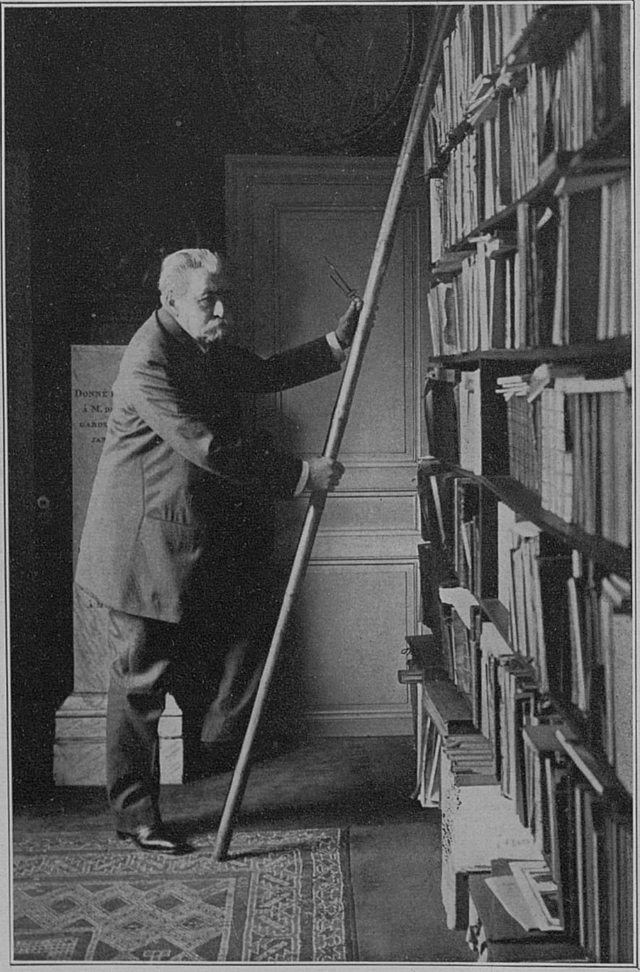
_Frédéric Masson dans sa bibliothèque, © fondation Dosne-Thiers_
</div>
Alexandre Leducq, conservateur de la Bibliothèque Thiers ; Corisande Evesque.
<a href="http://www.fondation-dosne-thiers.fr/" target="_blank"><img src="./images/FondationThiers_320x150.jpg" alt="Logo Fondation Dosne Thiers"></a></div>
*Mis en ligne : décembre 2023* |
|---|
| contenu de la page de présentation en markdown (en) | # Architectural drawings from the Fréderic Masson collection
## Introduction to the corpus
| Title | Architectural drawings from the Fréderic Masson collection |
|----------|-------------------------------------------------|
| Dates | 1788 - 1852 |
| Author | Multiple Authors |
|Volume of material | 84 drawings or sketches |
| Overview of contents | Historian Frédéric Masson assembled a collection of almost 1,000 drawings, now housed at the Bibliothèque Thiers. From this collection, the Fondation Napoléon and the Bibliothèque Thiers have assembled a set of 84 architectural drawings, representative of the production from the Revolution to the Second Empire. |
[See the documents !](https://www.napoleonica.org/fr/collections/architecture/search?page=0&pageSize=20)
## Detailed Description
Historian Frédéric Masson assembled a collection of almost 1,000 drawings, now housed at the Bibliothèque Thiers. From this collection, the Fondation Napoléon and the Bibliothèque Thiers have assembled a set of 84 architectural drawings representative of production from the Revolution to the Second Empire.
Under the direction of the Fondation Napoléon, this project was led by Adrián Fernández Almoguera, former member of the École Française de Rome and researcher at the Complutense University in Madrid, and Pierre Coffy, doctoral student in architectural history at the Université Panthéon-Sorbonne in Paris and the Università degli Studi, “La Statale” in Milan. Both are recipients of the Fondation Napoléon research grants. Other contributors to the description and commentary of the drawings were Charlotte Duvette, project manager for the "History of the Richelieu Quarter" project at the Institut national d’Histoire de l’Art (INHA), Paris, Studies and Research Department, and also a former Fondation Napoléon research grant recipient, and Guillaume Nicoud, post-doctoral fellow in Architectural History at the Archivio del Moderno, Università deal Svizzera Italiana, Lugano.
This team has put together a selection of figurative works grouped into several sets:
- 6 projects for monuments in honour of Napoleon: Statue of the Emperor as legislator of the Civil Code by Prud'hon (DM 386), projects for an equestrian statue (DM 250), or a monument (DM 251), etc.
- 14 drawings of monuments or commemorative projects: including projects for departmental commemorative columns for the city of Brussels (DM 413) or Boulogne (DM 258), projects for triumphal arches (DM 414), or the Pyramide d'Austerlitz erected by Marmont at the Bruges camp (DM 155 A), etc.
- 17 drawings or projects for public buildings or their decoration, including: Théâtre de Strasbourg (DM241 A), Church (DM 239 A-E), Corps législatif pediments (DM 34-4528) attributed to Chaudet, etc.
- 3 urban development projects: notably between the Louvres and the Tuileries (DM 262).
- 7 public amenity projects: Château d'Eau fountain (DM 418 C), Innocents fountain (DM 413 D), Tempietto (DM 34-3083), etc.
- 4 drawings for the interior fittings of imperial palaces or imperial festivals, including a project for a throne room (Dm 248), a study for the décor of the temporary chapel installed in the Salon Carré of the Louvre palace for the wedding of Napoleon and Marie-Louise on April 2, 1810 (DM 34-053).
- 3 private architectural drawings, including Villa Bonaparte in Milan (DM 228), Hôtel de Thélusson (DM 414 B).
- 1 early fortification drawing signed "Buonaparte" (DM 451).
- 27 preparatory drawings of fittings for the ceremony of the Return of Napoleon’s mortal remains, the “Retour des Cendres”, on December 15, 1840, or for Napoleon's tomb, signed by Labrouste and Visconti: catafalque (DM 202) funeral chariot (DM 4), stove (DM 218), horse carriages (DM 209), etc.
History and Conservation
<div class="text-small-image">
<div class="side-text">
The Napoleonic drawings in the Thiers Library collection came from a bequest made by Frédéric Masson to the Institut de France in 1923. These sheets, originally scattered among the historian's manuscripts, some of which framed, were assembled in the 1980s to form a coherent collection and arranged thematically.
In the 1970s, Hélène Michaud, curator of the Bibliothèque Thiers, planned to exhibit drawings from the collection on a rotating basis, though this project seems never to have come to fruition. More recently, in 1997, David Chanteranne compiled a new inventory of the drawings, which led to a number of new attributions.
It is not always easy to determine how Frédéric Masson bought his drawings: no evidence for it remains in his papers. However, we do know that some were obtained from major dealers, such as Elie Fabius, or at major auctions, such as the dispersal of the Marquis de Chennevières’ collection. Many were probably acquired in lots at minor auctions.
Whilst disparate, the Masson collection forms a coherent whole in the sense that all the items are related to Napoleonic iconography. Included are: a preparatory study by Jacques-Louis David for the painting of the coronation of Napoleon; a portrait of Jérôme Napoléon by François Gérard; and an engraving of General Pichegru by Alexandre-Evariste Fragonard. However, a significant number represent architectural elements, and it is this architectural corpus that the Fondation Napoléon and the Bibliothèque Thiers have decided to present here.
</div>

_Frédéric Masson in his library, © fondation Dosne-Thiers_
</div>
Alexandre Leducq, curator of the Bibliothèque Thiers; Corisande Evesque.
<a href="http://www.fondation-dosne-thiers.fr/" target="_blank"><img src="./images/FondationThiers_320x150.jpg" alt="Logo Fondation Dosne Thiers"></a></div>
*Online : December 2023* |
|---|
| contexte en markdown (fr) | # Les dessins d’architecture de la bibliothèque Thiers
<div class="text-small-image">
<div class="side-text">
À partir de 1789, l’architecture et l’aménagement urbain deviennent des instruments politiques à l’importance renouvelée. Dès lors, les régimes successifs de 1789 jusqu’à la Restauration, s’appuient particulièrement sur les architectes afin d’asseoir leur puissance. Cela représente une formidable opportunité pour les artistes, dont l’émulation est encouragée par un enchaînement rapide de bouleversements majeurs.
La construction de monuments publics, et la production d’architectures éphémères dans le cadre de grandes festivités, prennent notamment une importance significative. Il s’agit à la fois de transmettre de nouveaux idéaux, et de rallier la population au pouvoir en place. Au culte laïc de l’Être suprême de la Révolution, et à la célébration de la Nation, succède la glorification de la dynastie napoléonienne. Ce mouvement représente ainsi un champ d’expérimentation permanent, favorable à l’expression de différentes sensibilités stylistiques. Il alimente en outre le débat architectural international, d’abord porté par des cercles académiques réformés. La nécessité de légitimer le pouvoir en place passe également par un soin accru des autorités pour satisfaire les nouveaux besoins d’une société en évolution. Dans la lignée de la pensée des Lumières, elles encouragent le développement de nouveaux équipements politiques, administratifs et utilitaires, suscitant une nouvelle réflexion sur les types architecturaux. Cela favorise aussi la volonté de transformations urbaines à grande échelle, pour participer à un élan général de modernisation.
Si l’instabilité de la période révolutionnaire interdit toute réalisation concrète, malgré de nombreux projets aux dimensions frôlant parfois l’utopie, l’Empire est davantage propice à d’importants chantiers, dans un cadre cependant plus pragmatique. C’est l’occasion de mettre en œuvre, à travers de grands projets architecturaux et urbains, une nouvelle « romanisation » de l’Europe, à mesure que l’ordre napoléonien s’impose sur le continent.
</div>
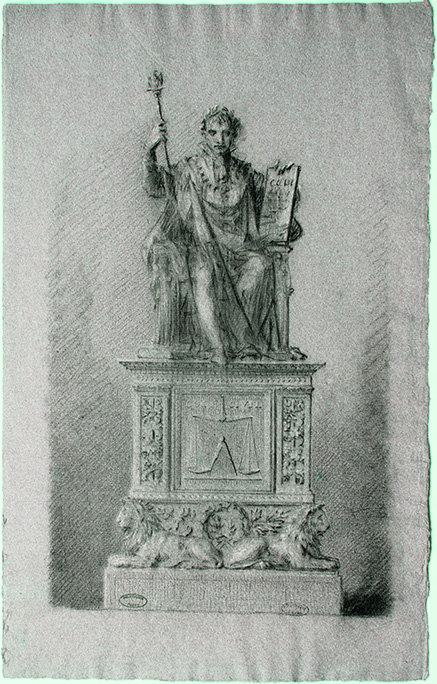
_Napoléon en législateur, Pierre-Paul Prud’hon, Bibliothèque Thiers, fonds Masson, DM 386 © Photo Fondation Napoléon - François Houdecek / Bibliothèque Thiers_
</div>
<div class="small-image-text">
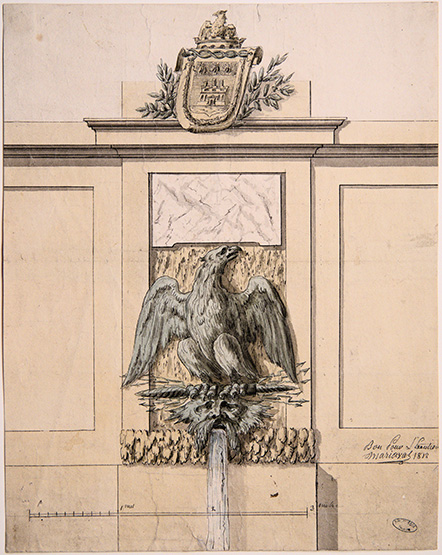
_Projet de fontaine, Bibliothèque Thiers, fonds Masson, DM 238 bis © Photo Fondation Napoléon - François Houdecek / Bibliothèque Thiers_
<div class="side-text">
La période comprise entre la Révolution et la Restauration se démarque ainsi par un nouvel essor de la production architecturale, dont la Fondation Dosne-Thiers conserve d’importants témoignages. À travers sa riche collection de dessins d’architecture, encore trop souvent ignorée, transparaît en effet une histoire artistique européenne marquée par des événements aussi fondamentaux que les concours révolutionnaires de l’an II, ou encore les projets pour la construction du Temple de la Grande Armée à partir de 1806. Le fonds comporte aussi une série de dessins relatifs à l’acte final de l’épopée napoléonienne, le retour des Cendres en 1840, qui pose entre autres la question de la construction d’un tombeau monumental pour l’Empereur.
Ce projet, soutenu par la Fondation Napoléon, a été conçu en collaboration avec la Fondation Dosne-Thiers comme une occasion de rendre cet ensemble davantage accessible à la communauté scientifique, et au public en général. Cela se concrétise à travers une sélection de dessins concernant exclusivement des projets architecturaux et urbains, puis leur étude depuis leur contexte de création, ce qui a parfois permis l’identification de certains projets emblématiques de la période, restés méconnus.
</div>
</div>
Adrián Fernández Almoguera, ancien membre de l’École française de Rome, et chercheur à l'Université Complutense de Madrid
Pierre Coffy, doctorant en Histoire de l’architecture à l’Université Panthéon-Sorbonne et l’Università degli Studi di Milano
*Mis en ligne : décembre 2023* |
|---|
| contexte en markdown (en) | # Thiers Library architectural drawings
<div class="text-small-image">
<div class="side-text">
From 1789 onwards, architecture and urban planning became political instruments of renewed importance. From 1789 to the Restoration, successive regimes relied heavily on architects to consolidate their power. This represented a tremendous opportunity for artists.
In particular, the construction of public monuments and the production of ephemeral architecture for major festivities took on significant importance. The aim of such construction was both to convey new ideals and to rally the population behind the ruling power. The secular worship of the Supreme Being during the Revolution and the celebration of the Nation were followed by the glorification of the Napoleonic dynasty. As the regimes and interests changed, so artists were presented with opportunities for experimentation and the expression of different stylistic sensibilities. The political flux also fuelled international architectural debate, which initially took place within reformed academic circles.
As the powers in place sought legitimacy, they directed greater attention to satisfying the ever-new expectations of a changing society. In line with the thinking of the Enlightenment, their actions encouraged the development of new politically driven structures, both administrative and utilitarian, stimulating new ideas regarding on architectural types. This general drive for modernization also fostered desires for large-scale urban transformation.
Though the Revolutionary period, fundamentally unstable as it was, prevented any concrete realisations (and indeed some of the many projects conceived at the time were on a scale that bordered on the utopian), the Empire on the other hand was more conducive to major construction projects, albeit within a more pragmatic framework. As the Napoleonic order took hold on the continent, there was a "Romanization" of Europe, through major architectural and urban projects.
</div>

_Napoleon as a lawmaker, Pierre-Paul Prud’hon, Bibliothèque Thiers, fonds Masson, DM 386 © Photo Fondation Napoléon - François Houdecek / Bibliothèque Thiers_
</div>
<div class="small-image-text">

_Project for a fountain, Bibliothèque Thiers, fonds Masson, DM 238 bis © Photo Fondation Napoléon - François Houdecek / Bibliothèque Thiers_
<div class="side-text">
The period between the Revolution and the Restoration was marked by a surge in architectural production, of which the Dosne-Thiers Foundation preserves important evidence. Its rich collection of architectural drawings reveals a European artistic history marked by such fundamental events as the Revolutionary architectural competitions of Year II, and the plans for the construction of the Temple de la Grande Armée from 1806 onwards. The collection also includes a series of drawings relating to the final act of the Napoleonic epic, the Return of the Napoleon’s mortal remains in 1840, which raised the question of the construction of a monumental tomb for the Emperor.
This project, supported by the Fondation Napoléon, was conceived in collaboration with the Fondation Dosne-Thiers as an opportunity to make this ensemble more accessible both to the academic community and to the general public. The corpus put on line is a selection of drawings relating exclusively to architectural and urban projects. Work for this project has provided an opportunity to study the context of the creation of the pieces, in some cases leading to the identification of certain emblematic projects of the period that had remained little-known.
</div>
</div>
Adrián Fernández Almoguera, former member of the École française de Rome, and researcher at the Complutense University, Madrid.
Pierre Coffy, doctoral student in architectural history at the Université Panthéon-Sorbonne and the Università degli Studi, “La Statale”, Milan.
*Online : December 2023* |
|---|
| est validée | oui |
|---|
| affichée en page d'accueil | oui |
|---|
| utilise les facettes | text,authors |
|---|
| Ordre d'affichage (plus petit nombre en haut) | 999 |
|---|
| |